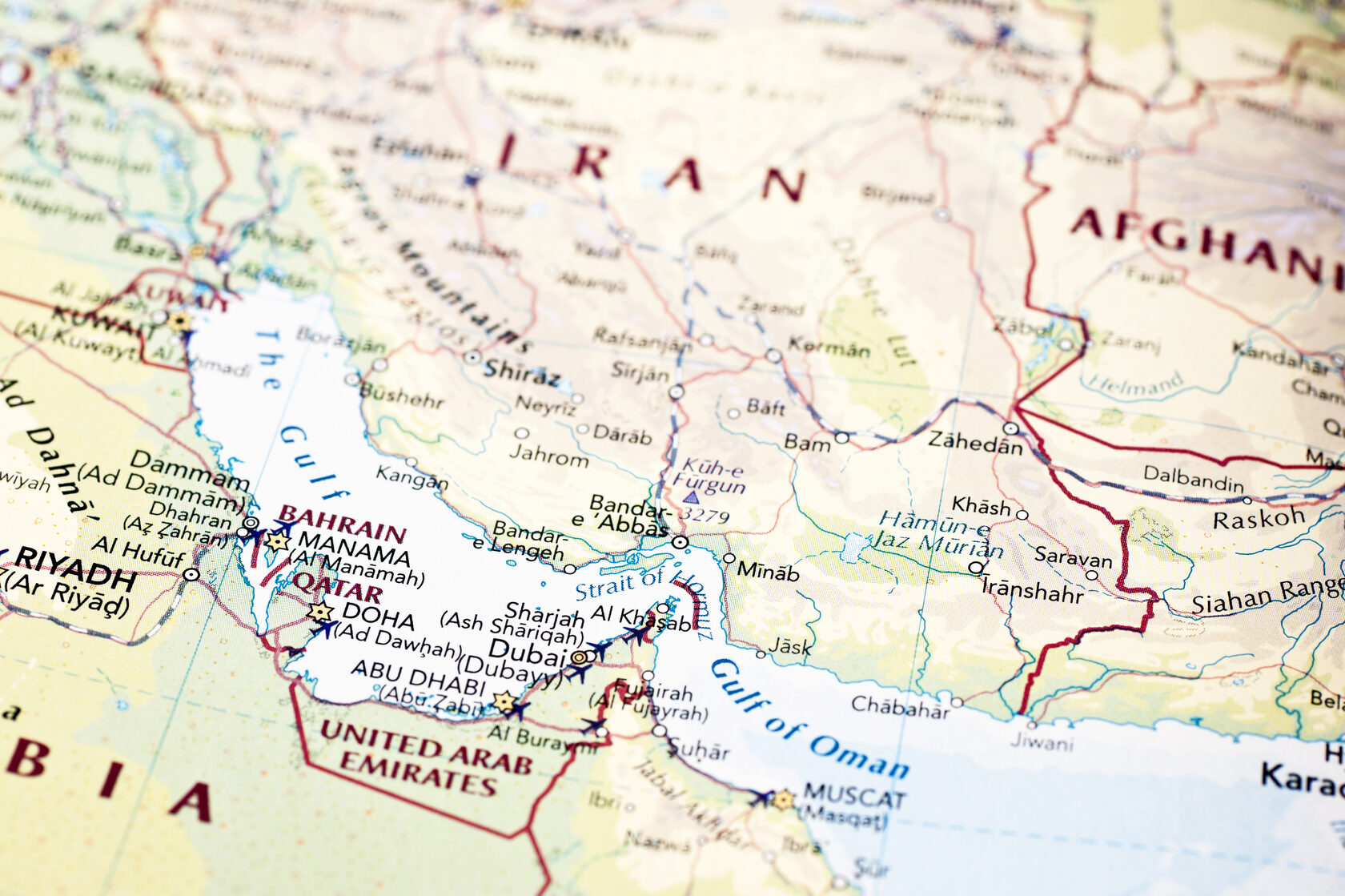
One in five barrels of oil traded globally moves through the Strait of Hormuz. Escalation there is legally more complex than it first appears.
What looks like a question of geopolitics and public international law is, in practice, resolved largely elsewhere: for commercial actors, meaningful remedies lie principally in international arbitration - under marine insurance policies, charterparties, and bills of lading - and, in some cases, in investment treaties.
Engaging state international responsibility could be ineffective
At its narrowest point, the Strait of Hormuz is approximately 21 nautical miles wide (39 km). Both Iran and Oman claim a 12-nautical-mile territorial sea pursuant to the United Nations Convention on the Law of the Sea (UNCLOS). The consequence is that the Strait is entirely overlapped by territorial seas. In international law, the Strait however qualifies as an “international strait used for international navigation” within the meaning of UNCLOS Part III (Articles 37-44). Accordingly, ships enjoy a right of transit passage (Article 38).
Article 44 provides that “States bordering straits shall not hamper transit passage and shall give appropriate publicity to any danger to navigation or overflight within or over the strait of which they have knowledge”.
Pursuant to Article 25.3 of the same convention“the coastal State may, without discrimination in form or in fact among foreign ships, suspend temporarily in specified areas of its territorial sea the innocent passage of foreign ships if such suspension is essential for the protection of its security, including weapons exercises. Such suspension shall take effect only after having been duly published.”
Iran has signed but not ratified the UNCLOS. Further, and following joint U.S.-Israeli strikes on Iran in February 2026, the Islamic Revolutionary Guard Corps (IRGC) began broadcasting radio warnings to vessels in the Strait of Hormuz declaring that “no ship is allowed to pass.” Iran did not declare a formal legal blockade, but warnings effectively halted maritime traffic in practice, with many tankers turning back or anchoring outside the strait due to safety concerns.
It has also been reported that at least three vessels were damaged. While under public international law the issue of state responsibility for such actions is an important concern, an immediate question for commercial parties is how to get compensated and whether their current insurance can account for such war risks.
In practical terms, disruption of the Strait of Hormuz would not simply raise crude oil and LNG prices; it would constrain physical supply, strain LNG markets, elevate insurance and shipping risk premiums, and transmit inflationary pressure globally. The severity of such economic impact would depend on the duration of the blocade since a short disruption causes volatility and a sustained closure becomes a structural shock to the global energy market.
Energy, Insurance and maritime arbitration disputes will be triggered
Marine insurance generally comes in two distinct layers. The first covers “ordinary” risks such as storms, accidents, mechanical failure and is bundled into standard hull and cargo policies. The second layer, war-risk insurance, is sold separately and covers losses arising from armed conflict, hostilities, terrorism, and insurgency.
Reports of war-risk underwriters issuing from 48- to 72-hour cancellation notices for vessels operating in the Gulf and Strait of Hormuz have caused concern across the industry. But from a legal standpoint, this is not necessary a violation of their contractual obligations. Cancellation clauses are standard features of war-risk policies - they exist precisely to allow insurers to exit or renegotiate cover when risk spikes sharply. Provided the insurer follows the notice period and service requirements set out in the contract, cancellation could be considered as valid.
The same logic applies to premium increases. Before recent escalations, war-risk premiums in the region were already elevated. Now, some are reportedly jumping by as much as 50%.
What procedural remedies are actually available?
Maritime disputes are usually resolved in arbitration under the rules published by the London Maritime Arbitrators Association (LMAA) with English law governing. Most marine policies require it, and arbitration remains the primary route to a declaration of continuing cover or a damages award. Unlike the London Court of International Arbitration (LCIA) or the International Chamber of Commerce (ICC) LMAA is not an arbitral institution and therefore the arbitration would be characterised as ad hoc meaning that the LMAA has no involvement in the conduct of such arbitration.
Energy-sector disruption claims (whether arising under SPAs, transportation arrangements, construction/EPC packages, or ancillary services) will often be channelled into arbitration under LCIA, ICC or DIAC rules, where force majeure / frustration arguments become a predictable battleground (termination vs suspension; total vs partial impossibility; allocation of risk and causation).
DIFC law, which codifies principles of common law, provides a convenient illustration of the principles of substantive law at play.
Force majeure is recognised within the DIFC legal framework. Under Article 82 of DIFC Law No. 6 of 2004 (the DIFC Contract Law), a party may be relieved of liability for non-performance if it can demonstrate that the failure to perform resulted from an obstacle outside its control, and that it could not reasonably have been expected to foresee that obstacle at the time the contract was entered into, nor to have avoided or mitigated it or its effects. Notably, this exemption does not extend to a simple obligation to make payment.
Article 86(2) of the same law sets out the criteria for assessing whether a failure to perform rises to the level of a fundamental non-performance. The following factors are to be considered:
(i)whether the non-performance substantially deprives the affected party of the benefit it was entitled to expect from the contract;
(ii)whether exact compliance with the unperformed obligation was essential to the contract;
(iii)whether the failure to perform was deliberate or carried out with reckless disregard; and
(iv)whether the non-performance gives the affected party reasonable grounds to doubt the other party's willingness or ability to fulfil its future obligations.
Investment treaties’ war clauses concluded between Gulf States and Iran
Iran maintains a network of bilateral investment treaties (BITs) with several States, including three Gulf Cooperation Council (GCC) members: Kuwait (in force since March 2011) Qatar (in force since November 2001) and Oman (in force since 2003).
These treaties contain a compensation for losses clause which reads “investors of either contracting party whose investments suffer losses due to any armed conflict, revolution or similar state of emergency in the territory of the other Contracting Party shall be accorded by the other Contracting Party treatment no less favourable than that accorded to investors of any third country”.
Compensation for losses clauses in investment treaties operate as a derogatory regime (lex specialis) for compensating wartime damage, but their scope varies significantly depending on drafting. This formulation establishes a Most-Favoured-Nation (MFN) standard limited to war losses which means that if a State decides to compensate its investors and/or foreign investors for losses resulting from wartime destructions, it will have to accord to the beneficiary of such MFN clause a treatment (compensation) no less favorable than it accords to others.
Contact a crisis management group
Immediate engagement with a specialised crisis management group is essential to coordinate legal, operational, reputational, and security responses in a conflict or emergency scenario. Such teams provide rapid risk assessment, asset-mapping, stakeholder communication strategy, sanctions screening, and evidence preservation protocols - all of which are critical for protecting value and positioning the company for potential insurance recovery or investment treaty claims.
Anastasia Medvedskaya has recently joined The Mentors Group in Dubai as specialist consultant for international arbitration disputes.
You can address you queries at amm@thementors.group
What looks like a question of geopolitics and public international law is, in practice, resolved largely elsewhere: for commercial actors, meaningful remedies lie principally in international arbitration - under marine insurance policies, charterparties, and bills of lading - and, in some cases, in investment treaties.
Engaging state international responsibility could be ineffective
At its narrowest point, the Strait of Hormuz is approximately 21 nautical miles wide (39 km). Both Iran and Oman claim a 12-nautical-mile territorial sea pursuant to the United Nations Convention on the Law of the Sea (UNCLOS). The consequence is that the Strait is entirely overlapped by territorial seas. In international law, the Strait however qualifies as an “international strait used for international navigation” within the meaning of UNCLOS Part III (Articles 37-44). Accordingly, ships enjoy a right of transit passage (Article 38).
Article 44 provides that “States bordering straits shall not hamper transit passage and shall give appropriate publicity to any danger to navigation or overflight within or over the strait of which they have knowledge”.
Pursuant to Article 25.3 of the same convention“the coastal State may, without discrimination in form or in fact among foreign ships, suspend temporarily in specified areas of its territorial sea the innocent passage of foreign ships if such suspension is essential for the protection of its security, including weapons exercises. Such suspension shall take effect only after having been duly published.”
Iran has signed but not ratified the UNCLOS. Further, and following joint U.S.-Israeli strikes on Iran in February 2026, the Islamic Revolutionary Guard Corps (IRGC) began broadcasting radio warnings to vessels in the Strait of Hormuz declaring that “no ship is allowed to pass.” Iran did not declare a formal legal blockade, but warnings effectively halted maritime traffic in practice, with many tankers turning back or anchoring outside the strait due to safety concerns.
It has also been reported that at least three vessels were damaged. While under public international law the issue of state responsibility for such actions is an important concern, an immediate question for commercial parties is how to get compensated and whether their current insurance can account for such war risks.
In practical terms, disruption of the Strait of Hormuz would not simply raise crude oil and LNG prices; it would constrain physical supply, strain LNG markets, elevate insurance and shipping risk premiums, and transmit inflationary pressure globally. The severity of such economic impact would depend on the duration of the blocade since a short disruption causes volatility and a sustained closure becomes a structural shock to the global energy market.
Energy, Insurance and maritime arbitration disputes will be triggered
Marine insurance generally comes in two distinct layers. The first covers “ordinary” risks such as storms, accidents, mechanical failure and is bundled into standard hull and cargo policies. The second layer, war-risk insurance, is sold separately and covers losses arising from armed conflict, hostilities, terrorism, and insurgency.
Reports of war-risk underwriters issuing from 48- to 72-hour cancellation notices for vessels operating in the Gulf and Strait of Hormuz have caused concern across the industry. But from a legal standpoint, this is not necessary a violation of their contractual obligations. Cancellation clauses are standard features of war-risk policies - they exist precisely to allow insurers to exit or renegotiate cover when risk spikes sharply. Provided the insurer follows the notice period and service requirements set out in the contract, cancellation could be considered as valid.
The same logic applies to premium increases. Before recent escalations, war-risk premiums in the region were already elevated. Now, some are reportedly jumping by as much as 50%.
What procedural remedies are actually available?
Maritime disputes are usually resolved in arbitration under the rules published by the London Maritime Arbitrators Association (LMAA) with English law governing. Most marine policies require it, and arbitration remains the primary route to a declaration of continuing cover or a damages award. Unlike the London Court of International Arbitration (LCIA) or the International Chamber of Commerce (ICC) LMAA is not an arbitral institution and therefore the arbitration would be characterised as ad hoc meaning that the LMAA has no involvement in the conduct of such arbitration.
Energy-sector disruption claims (whether arising under SPAs, transportation arrangements, construction/EPC packages, or ancillary services) will often be channelled into arbitration under LCIA, ICC or DIAC rules, where force majeure / frustration arguments become a predictable battleground (termination vs suspension; total vs partial impossibility; allocation of risk and causation).
DIFC law, which codifies principles of common law, provides a convenient illustration of the principles of substantive law at play.
Force majeure is recognised within the DIFC legal framework. Under Article 82 of DIFC Law No. 6 of 2004 (the DIFC Contract Law), a party may be relieved of liability for non-performance if it can demonstrate that the failure to perform resulted from an obstacle outside its control, and that it could not reasonably have been expected to foresee that obstacle at the time the contract was entered into, nor to have avoided or mitigated it or its effects. Notably, this exemption does not extend to a simple obligation to make payment.
Article 86(2) of the same law sets out the criteria for assessing whether a failure to perform rises to the level of a fundamental non-performance. The following factors are to be considered:
(i)whether the non-performance substantially deprives the affected party of the benefit it was entitled to expect from the contract;
(ii)whether exact compliance with the unperformed obligation was essential to the contract;
(iii)whether the failure to perform was deliberate or carried out with reckless disregard; and
(iv)whether the non-performance gives the affected party reasonable grounds to doubt the other party's willingness or ability to fulfil its future obligations.
Investment treaties’ war clauses concluded between Gulf States and Iran
Iran maintains a network of bilateral investment treaties (BITs) with several States, including three Gulf Cooperation Council (GCC) members: Kuwait (in force since March 2011) Qatar (in force since November 2001) and Oman (in force since 2003).
These treaties contain a compensation for losses clause which reads “investors of either contracting party whose investments suffer losses due to any armed conflict, revolution or similar state of emergency in the territory of the other Contracting Party shall be accorded by the other Contracting Party treatment no less favourable than that accorded to investors of any third country”.
Compensation for losses clauses in investment treaties operate as a derogatory regime (lex specialis) for compensating wartime damage, but their scope varies significantly depending on drafting. This formulation establishes a Most-Favoured-Nation (MFN) standard limited to war losses which means that if a State decides to compensate its investors and/or foreign investors for losses resulting from wartime destructions, it will have to accord to the beneficiary of such MFN clause a treatment (compensation) no less favorable than it accords to others.
Contact a crisis management group
Immediate engagement with a specialised crisis management group is essential to coordinate legal, operational, reputational, and security responses in a conflict or emergency scenario. Such teams provide rapid risk assessment, asset-mapping, stakeholder communication strategy, sanctions screening, and evidence preservation protocols - all of which are critical for protecting value and positioning the company for potential insurance recovery or investment treaty claims.
Anastasia Medvedskaya has recently joined The Mentors Group in Dubai as specialist consultant for international arbitration disputes.
You can address you queries at amm@thementors.group